

At the Well Still Means Netback: Market-Enhancement Clauses Can Be Surplusage
Texas allocates gathering, compression, and processing by the royalty clause, not by a marketable-product speech borrowed from other states. An at-the-well valuation usually lets the operator netback those costs, and a no-deduct rider that never rewrites the valuation point often does no work.

TL;DR
The problem: you own a share of a well, and the check is smaller than the sale price. The lease says “at the well,” which prices your share where the oil or gas comes out of the ground, not where it is sold.
The way through it: subtract the cost of moving it to a buyer, then take your percentage of what is left. That subtraction is called netback. Extra words like “no deductions” or “market enhancement” matter only if they change the place where your share is priced. If they do not, they do no work.
You are at the kitchen table with a check stub from a well that did not exist when the lease was signed. The printed form values gas at the well. A form-book rider says the lessee will not deduct costs to make the product marketable, except reasonable costs that enhance value after it is already marketable. Then the shale play showed up, and with it a gathering system, a compressor station, and a plant you will never see. The stub takes those costs off before your fraction.

You want the implied covenant to market to swallow the midstream bill. The court wants the valuation point in the four corners. Those are not the same fight. Judges in producing counties have heard the other speech since 9 a.m.
The implied covenant that does not eat the lease
Texas still implies a covenant to market. A reasonably prudent operator must market production within a reasonable time and at the best price reasonably obtainable. That is a duty to sell. It is not a duty to donate the gathering line.
Other states tell a thicker story. Colorado, Kansas, and Oklahoma are the usual imports: the lessee bears every cost required to put gas into a marketable condition, and only later costs are shared. Texas does not run that first-marketable-product machine as a free-floating rule that overrides the royalty clause. The implied covenant cannot contradict express allocation language. If the lease fixes where value is measured, or how costs are handled, that text is the case.
Bring the marketable-product folklore into a Texas lease and you have described a different jurisdiction. The clerk will not care that the rider felt protective in 1994.
At the well is a location, not a mood
Royalty clauses are ordinary contracts. Read the grammar, then read the whole instrument. There is no hallway presumption that “royalty” means the downstream proceeds check.
An “at the well” or “market value at the well” clause values the lessor’s fraction at the wellhead. Modern gas is rarely sold there. Courts therefore allow a netback, sometimes called a workback: start with the downstream price, then subtract reasonable post-production costs incurred between the wellhead and the point of sale. Gathering, dehydration, compression, transportation, and processing are the usual inputs. Those items are not a tip for the operator. They are the arithmetic used to reconstruct wellhead value.
Move the clause to “amount realized,” “gross proceeds,” or value at the point of sale, and the baseline moves with it. Absent contrary text, that language generally does not let the operator peel the same costs off the price it actually received. The lessor is sharing in what was realized downstream, not in a reconstructed wellhead number.
That split decides the file. Valuation at the well: netback is the default machine. Valuation on proceeds at the sale: deductions need permission in the instrument. The rider has to be read against that baseline. It does not get read against what the family thought “no deductions” meant while the landman was still in the driveway.
The caption on the stub is marketing. “Gathering” on an affiliate invoice does not decide whether the work is a production cost the lessee already owes or a post-production cost that feeds a netback. Where the work happens, and what the lease values, are the questions. The midstream company’s label is not.
When the market-enhancement clause becomes surplusage
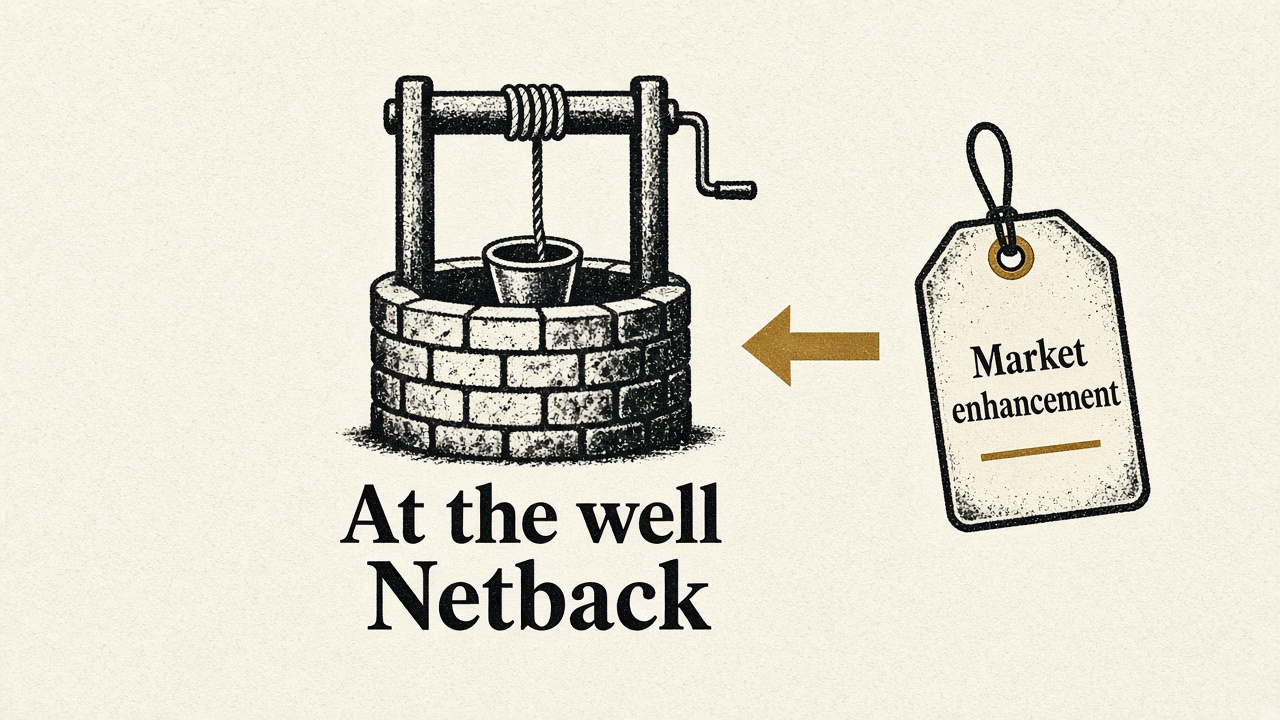
A market-enhancement clause usually says the lessee may not deduct post-production costs unless the spend enhances an already marketable product and is reasonable. It sounds like a shield. Parked next to an at-the-well printed form, Texas history has often treated it as a sentence that does no work.
The research lead everyone still names is Heritage Resources, Inc. v. NationsBank. Treat the style of cause as a lead, not a password. Verify the opinion, and what later cases did to it, before you file. The holding people fight about is this: if the royalty is already valued at the well, a promise not to deduct post-production costs does no extra work. Those costs are not subtracted from a finished royalty. They are the inputs used to find wellhead value. You can call them deductions in the rider. The valuation point still controls. That is how at-the-well math works.
Later Texas Supreme Court opinions are the rest of the file. Chesapeake Exploration, L.L.C. v. Hyder, Burlington Resources Oil & Gas Co. LP v. Texas Crude Energy, LLC, and BlueStone Natural Resources II, LLC v. Randle are the names that get dropped in demand letters. Verify each one. The pattern they are used to support is not “Heritage forever.” Parties may contract around the default. They have to do it with actual clarity.
If an addendum moves the royalty base to amount realized or proceeds, a market-enhancement clause can function as a narrow gate: some enhancement costs come off, the rest stay on the check. If the addendum never displaces “at the well,” courts have been willing to call the no-deduct language surplusage. An exhibit that says it controls over the printed form helps only if it actually rewrites the valuation point. “Controls” is not a spell. The question is what the controlling sentence changed.
Some leases say both. Proceeds in one paragraph, at the well in another, a rider in the packet. That is not a flourish. It is the lawsuit. Do not assume the rider wins because it is later, typed, or angrier. Mixed language is why those later cases exist. Read them against your pages.
Pre-shale riders were drafted for a gathering system that often did not exist. Applying that sentence to a centralized gathering network, an NGL plant, and a keep-whole or percentage-of-proceeds processing deal is how these files grow a banker’s box. The court will still ask whether the parties redefined the royalty base. It will not ask whether the play surprised the lessor.
What you recover if the deductions were wrong
If the operator took gathering, compression, or processing the lease does not allow, the ordinary claim is breach of contract for underpaid royalties. The measure is the money that should have been on the stub. It is not a speech about shale.
Attorney’s fees can ride with a contract claim under Tex. Civ. Prac. & Rem. Code § 38.001 if the statutory conditions, including presentment, are met. Read the current text. Do not treat the section as a fee-shifting lottery.
Unpaid or late proceeds also live in the Texas Natural Resources Code. Tex. Nat. Res. Code §§ 91.401 - 91.408 set payor duties, timing, and interest. Section 91.402 is the payment clock. Section 91.403 is the interest machine when proceeds sit outside the statutory windows without a recognized justification, such as a genuine title dispute. The rate formula is in the statute. Confirm it on Texas Legislature Online before you plead a number. Statutes move.
When the midstream contracts, plant allocation statements, and affiliate invoices sit only in the operator’s cabinet, lessors sometimes plead an accounting. That is a books problem. It is not a second royalty clause.
What you generally do not get is the lease back. Texas treats the covenant to pay royalty as independent, not as a condition subsequent. Underpayment is a damages case. Forfeiture or cancellation requires an express special limitation or condition that actually says failure to pay, or improper deduction, ends the estate. Pre-shale forms rarely handed you that clause. Do not plead termination because the deductions look greedy. Greedy is not a special limitation.
The four-year lookback and the stub you did not decode
Breach of contract for royalty underpayment is a four-year claim. Counsel usually pin that to Tex. Civ. Prac. & Rem. Code § 16.004. Confirm the subsection that fits the pleading. The discovery rule is not a second chance for every stale deduction code. Texas has been stingy about calling royalty underpayments inherently undiscoverable when check stubs, Railroad Commission production filings, and a demand for documents were sitting there. HECI Exploration Co. v. Neel is the name that shows up in the briefing. Verify it. The clock does not care that you were not in the habit of reading the stub.
Affiliate gathering is the other expensive pattern. A non-arm’s-length midstream deal can be attacked as unreasonable, or as a pricing scheme that depresses wellhead value on a netback lease. That is proof: actual costs, comparable rates, keep-whole versus fee-based plant contracts, NGL fractionation statements. You have not won because the buyer and the gatherer share a logo. You have described a file that needs the contracts.
In liquids-rich shale, the fight often hides in the plant. Value gets split, allocated, and sometimes kept whole in oil. The lease still has to say who bears that machinery. Downstream paper, however thick, does not by itself move an at-the-well royalty to the tailgate.
The trap
The trap is fighting the implied covenant, or waving the market-enhancement rider, before you decide what the royalty is valued on. If the lease still says at the well, netback is the machine and the rider may be surplusage. If the lease, or a controlling addendum, moved the base to proceeds or amount realized, the same gathering fee can be an improper deduction. The difference is a sentence, not a play name. It is the sentence the court will want.
Run the actual clause, the addendum hierarchy, and the deduction codes through Texas Law Bot if you need a research pass on the current cases and Chapter 91. It is a research tool, not counsel table.
This is commentary on general Texas legal research, not legal advice, and not a substitute for a lawyer who has read your lease and the midstream contracts behind the stub.