

Forcible Detainer Is a Possession Fight, Not Your Lease Lawsuit
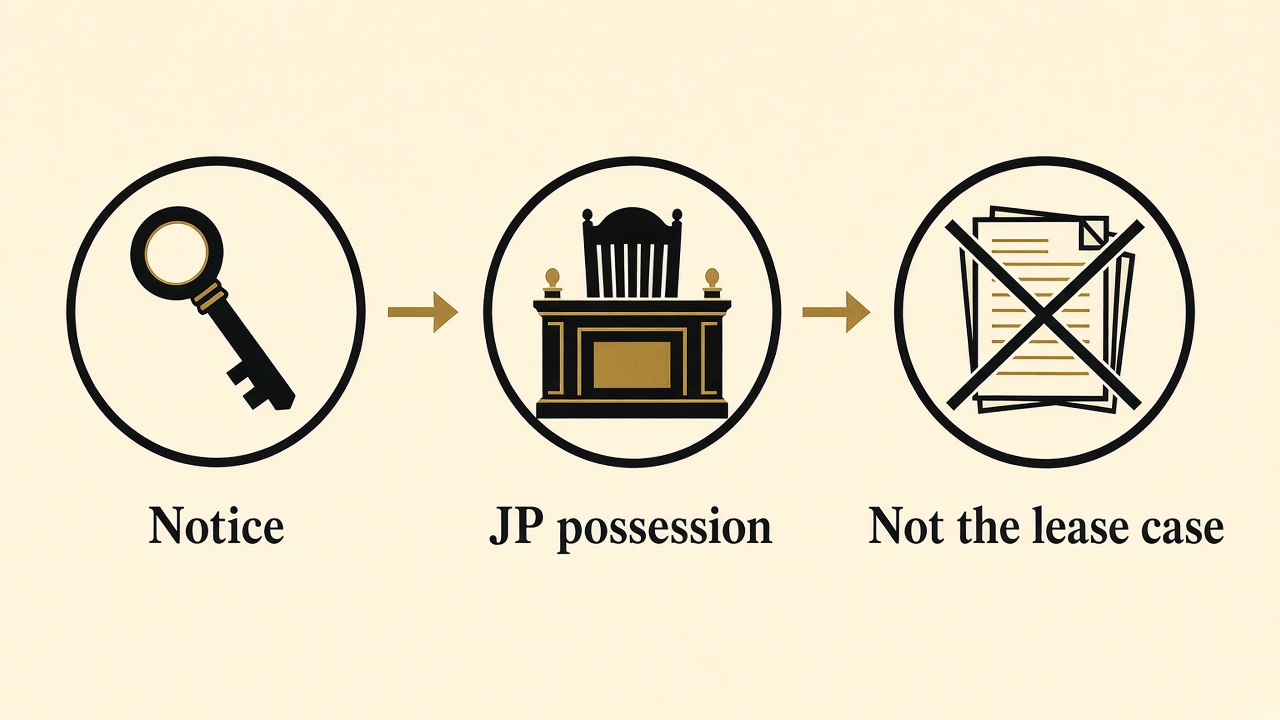
Texas eviction is a JP-court case about who gets the keys right now, not a full breach-of-lease trial. The notice, the missing cure right, and a short list of defenses usually decide it.

TL;DR
The problem: a landlord wants someone out, and files in the small court as if that case will settle the whole lease. It will not. That court only decides who gets to stay in the place right now.
The way through it: treat possession as its own short case. Warn the person properly, serve the papers the right way, and do not change the locks yourself. Save unpaid rent, damage, and who owns the place for a different lawsuit.
Monday morning in Justice of the Peace court, usually called JP court (the small local court that handles evictions, small claims, and speeding tickets), the eviction docket is a line of people holding the wrong argument. Landlords bring texts about late rent and photos of a stained carpet. Tenants come ready to talk about the dead A/C, the deposit, and who promised what in May. The court, more often than not, wants one thing: who has the right to immediate actual possession of this property. Everything else is someone else’s lawsuit.

That is forcible detainer. Treat it like an ordinary breach-of-lease claim and you will learn the difference the hard way.
Possession only, and only here
Chapter 24 of the Texas Property Code and Rules 500 through 510 of the Texas Rules of Civil Procedure built a summary machine. Justice courts have exclusive original jurisdiction over eviction. Tex. Gov’t Code § 27.031(a)(2); Tex. Prop. Code § 24.004. The sole issue tried is the right to immediate possession. Tex. R. Civ. P. 510.3(e). You can sometimes pick up delinquent rent that fits inside the JP court’s limit, a writ of possession, and statutory attorney’s fees under Property Code § 24.006. You do not get to bolt on property-damage claims, independent torts, or a fight about who really owns the place. Rule 510.3(e) is not a suggestion.
A regular lease lawsuit lives under ordinary civil rules. Damages, specific performance, declaratory relief, the whole contractual mess, usually in county court at law or district court. If the dollars are small enough, a JP court can hear a damages case too. That is still a different suit. You do not join it to the eviction.
Two statutory flavors, because Texas likes its labels.
Forcible entry is the person who got onto the property without legal authority, by force, stealth, or intimidation. Property Code § 24.001.
Forcible detainer is the everyday docket. The occupant came in lawfully, as a tenant or as a borrower after foreclosure, then refused to leave after the right to possession ended. Property Code § 24.002. Most residential files are detainer cases. Someone had a key. Then, according to the landlord, they didn’t.
The three-day notice, and the cure period that usually is not there
Here is the part that surprises people who moved from a state with a statutory right to cure.
Chapter 24 does not give residential or commercial tenants a general statutory right to cure a default, rent or otherwise, once the landlord elects to terminate. If you want a cure window, you find it in the written lease or in a federal overlay. Not in the eviction chapter.
Unless a written lease says otherwise, the landlord must give at least three days’ written notice to vacate before filing. Property Code § 24.005. The lease can shorten that or lengthen it. Some leases try 24 hours. Some give ten days. The statute bows to the written contract on the length.
Termination and notice to vacate are not the same paper. A month-to-month tenancy or tenancy at will usually needs a termination notice first, typically 30 days under Property Code § 91.001, unless the lease says something different. You can combine them. You cannot pretend a three-day vacate letter ended a tenancy that still had a month to run.
Nonpayment versus other defaults does not magically create a cure right. If the lease requires a ten-day default notice and a chance to catch up the rent, the landlord cannot skip that step and jump to a notice to vacate. Contract first. Then the three-day (or whatever the lease substituted) notice to get out.
Federal housing is the asterisk. Section 4024 of the CARES Act, 15 U.S.C. § 9058, requires a 30-day notice to vacate for nonpayment on properties with federally backed mortgages or covered housing programs. Whether that 30-day notice survived after other CARES Act moratorium pieces expired is still being fought in Texas appellate courts. Some intermediate courts have treated the 30-day notice as a lasting requirement for covered properties. That is unsettled enough that you should not guess from a blog post. Check current law for the property in front of you.
What the notice has to say, and how it has to arrive
Property Code § 24.005 is picky, and JP courts have seen every homemade version.
The notice has to demand possession, clearly and unconditionally. Vacate by this date, or after this many days. “Pay or get out” language can get read as a default notice instead of a true notice to vacate, unless the lease or local practice allows the alternative. If you want the tenant gone, say they have to leave.
State the grounds. Nonpayment, lease violation, holding over, end of an at-will tenancy. A mystery letter that just says “get out” invites a fight about whether anyone was told why.
If the landlord wants statutory attorney’s fees under § 24.006, the notice has to say that if the tenant does not vacate before the 11th day after receipt, the landlord may file and seek fees. Miss that sentence, miss the fees. Plenty of otherwise decent notices die on that one line.
Delivery is not a text, a Facebook message, or a note under the wiper. Section 24.005(f) and the follow-on subsections list the methods: personal delivery to the tenant or to anyone 16 or older living there; affixing the notice to the inside of the main entry door; regular, registered, or certified mail to the premises. There is a narrow alternative for posting on the outside of the door in a sealed envelope with the statutory warnings, plus a same-day mailing, and only if there is no mailbox and the landlord cannot get in because of a dangerous animal, a keyless bolt, or bad weather. That last method is not the Tuesday convenience option, no matter how wet the porch is.
File before the notice period runs and you filed too soon. Defective notice is not a technicality in this proceeding. It is often the whole case.
What a tenant can actually say at trial
The JP court is fast. It is not a rubber stamp if somebody shows up with a real defense.
Defective notice, premature filing, or sloppy delivery under § 24.005 can end the possession claim. Citation and service still have to follow Rule 510.4. Skip the officer, skip the alternative-service findings, and you may not have a lawsuit yet.
Title is the jurisdictional landmine. Justice courts cannot try title. Tex. Gov’t Code § 27.031(b)(4). If the right to immediate possession cannot be decided without resolving who owns the property, the JP court may lack subject-matter jurisdiction. Think executory contracts and contracts for deed, or a post-foreclosure fight with no landlord-tenant relationship to lean on. How far that argument travels on a given set of facts is something you verify against current cases. A speech that begins “I really own this” does not automatically get you out of JP court.
Statutory retaliation lives in Property Code §§ 92.331 through 92.335. A landlord generally may not evict within six months after the tenant exercises certain lawful rights, such as a good-faith complaint to code enforcement or a repair request under Chapter 92. The catch is ugly and often decisive: if the tenant is already behind on rent when the notice is served, retaliation is generally not available. § 92.332(b)(1). The statute protects the tenant who used the repair process. It does not freeze the docket for someone who stopped paying and then found a code complaint.
Waiver still matters. Taking rent for a period after the notice to vacate, without an express reservation of rights, can waive the breach and put the tenancy back on its feet. Landlords who cash the money order and then act shocked at trial have seen this movie.
Tender of the delinquent rent before the lease was lawfully terminated, or while a contractual cure right still existed, can matter. After a clean termination and a clean notice to vacate, waving cash in the hallway is a different conversation.
Repair-and-deduct done by the book under Property Code § 92.0561 can be a defense to the nonpayment piece, up to the statutory amount. Done by the book means the statute’s steps, not a hardware-store receipt and a speech about mold.
Federal overlays show up when they show up. CARES Act notice, if the property is covered and if a court in your area still treats that 30-day rule as alive. VAWA, 34 U.S.C. § 12491, if the eviction is based on domestic violence, dating violence, sexual assault, or stalking against a covered tenant. Fair Housing Act claims, including failure to grant a reasonable accommodation to a person with a disability. The Servicemembers Civil Relief Act, 50 U.S.C. § 3935, for active-duty servicemembers and their dependents: court approval, and a possible stay of up to 90 days.
The trap people still walk into
Landlords who change locks, pull doors, or cut the lights on a residential tenant are not “enforcing the lease.” They are inviting actual damages, a statutory penalty of one month’s rent plus $1,000, and attorney’s fees. Property Code §§ 92.008 and 92.0081. Even a lockout has to leave the tenant a way back in on request. Self-help is how you turn a three-day possession case into a much more expensive problem.
Tenants who skip the hearing because they plan to explain it later meet a writ of possession. Appeal is de novo in county court under Rule 510.9. You have five days from the JP judgment to file a supersedeas bond or a Statement of Inability if you want to stay the writ. The clock does not care that you were on shift.
Statutes move. If you are relying on a number you memorized two sessions ago, look it up on Texas Legislature Online before you file or before you tell a client it is fine.