

Joint Conservators Until Family Violence Walks In: Texas SAPCR Conservatorship and Possession
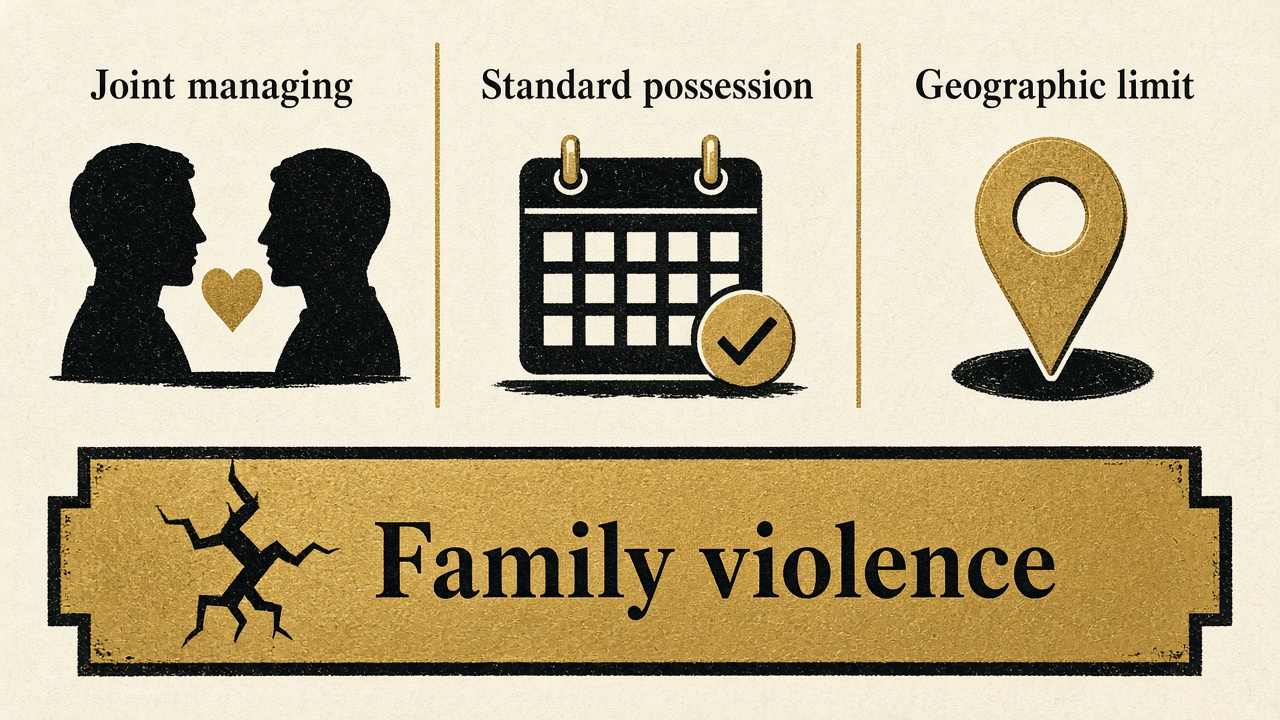
Texas SAPCR law starts with a joint-managing-conservator presumption and a standard possession order. Family violence can take both off the table, and a JMC decree still has to say whether the child's primary residence lives inside a geographic box.

TL;DR
The problem: a custody fight starts from what feels fair, or from an old form, and misses what Texas actually starts from.
The way through it: start with the usual rules. Both parents share major decisions, follow a standard schedule for time with the child, and live inside a set area. Family violence can change those rules. The court order has to say who has the child and when.
The hallway outside a SAPCR docket still runs on paper, coffee, and the phrase “best interest of the child.” One parent heard “joint” and thinks the Code sold them a timeshare. The other heard it and thinks there is no geographic leash. The court has a statute, and the statute is pickier than the hallway.

Joint is a label, not a calendar
In a Suit Affecting the Parent-Child Relationship, “best interest” is not filler. Tex. Fam. Code § 153.002 says the best interest of the child is always the primary consideration when the court decides conservatorship, possession, and access. Chapter 153 is the machinery.
Section 153.001 puts the State’s public policy on the first page of the chapter. Orders are supposed to keep children in frequent and continuing contact with parents who have shown they can act in the child’s best interest. They are supposed to provide a safe, stable, and nonviolent home. They are supposed to encourage parents to share rights and duties after the split. Those three goals get along until they do not. When they do not, the nonviolent-environment piece tends to eat the sharing piece. That is not a glitch.
Texas then layers two presumptions on that policy.
First, unless appointment of a parent would significantly impair the child’s physical health or emotional development, a parent gets named a sole managing conservator or both parents get named joint managing conservators. That is § 153.131(a). Then § 153.131(b) adds the part people quote in the hallway: there is a rebuttable presumption that appointing both parents as joint managing conservators is in the child’s best interest.
Second, there is a rebuttable presumption that the Standard Possession Order in Subchapter E is the reasonable minimum possession for a possessory conservator or a joint managing conservator, and that it is in the best interest of a child three or older. That is § 153.252.
JMC is not a timeshare. It is a label for how rights and duties get split. You can be joint managing conservators and still have a lopsided possession schedule. You can also be JMCs and still have one parent holding the exclusive right to designate the child’s primary residence. If you walk in thinking “joint” means every other week and no county line, Chapter 153 is going to disappoint you.
If the parents do not agree on JMC, the court may still order it, but only if that appointment is in the child’s best interest after looking at the factors in § 153.134(a). Those include whether the child’s physical, psychological, or emotional needs would benefit from JMC, whether the parents can put the child first and actually make shared decisions, whether each parent can stand a positive relationship between the child and the other parent, whether both parents were in the child-rearing mix before the suit was filed, how close the homes are, and, if the child is 12 or older, the child’s preference on who should have the exclusive right to designate primary residence, taken in chambers under § 153.009. Plus any other relevant factor. The Code is not pretending the list is closed.
Chapter 153 does not hand you a neat statutory checklist of best-interest factors for every custody fight. Courts still talk about the common-law Holley factors: the desires of the child, present and future needs, danger, parental abilities, available programs, plans for the child, stability of the home, and the parent’s acts or omissions. Treat Holley v. Adams as background knowledge that needs verification before you cite it like gospel. The statute you can actually put your finger on is still § 153.002.
When family violence takes the presumption off the table
Then family violence is in the record, and the presumption stops being a presumption.
Under § 153.004(a), the court may not appoint joint managing conservators if credible evidence shows a history of past or present physical or sexual abuse, or family violence as defined in § 71.004, by one parent against the other parent, a spouse, or any child. The same history knocks out the JMC presumption in § 153.131(b). Section 153.004(b) then stacks a different presumption: it is not in the child’s best interest to appoint that parent as sole managing conservator, or as the conservator with the exclusive right to designate primary residence, if there is credible evidence of a history or pattern of child neglect, physical or sexual abuse, or family violence.
The court has to look at certain proof. It must consider whether a protective order under Title 4 was rendered against the parent in the two years before the suit was filed (§ 153.004(f)). It shall consider evidence of intentional abusive physical force or sexual abuse in the two years before the suit or during the suit (§ 153.004(c)). Allegations still need competent, credible evidence. A two-year-old protective order, a conviction, a deferred adjudication, and uncorroborated hallway testimony are not the same thing. Trial courts get a wide lane on credibility. That is the statute, not a defect you argue away with adjectives.
Possession gets tighter too. Under § 153.004(d), the court may not allow a parent access if there is a history of physical or sexual abuse or family violence, unless the court finds that access would not endanger the child’s physical health or emotional welfare and then writes an order designed to protect the child and any other victim. Section 153.004(d-1) presumes unsupervised access is not in the child’s best interest if the court finds a history of family violence within the two years before the suit. Section 153.004(e) points the court toward protective conditions: supervised visits, exchanges in a protective setting, no alcohol or controlled substances within 12 hours of possession, completion of a battering intervention program. This is the Code taking the safety goal in § 153.001 more seriously than anyone’s preferred weekend.
The standard order, and the writing when you leave it
Children under three do not get the SPO presumption by default. Section 153.254 tells the court to write an order that fits the circumstances, looking at who actually did the caregiving, what separation does to the child, who is available, the child’s needs, the parents’ conditions, and anything else that bears on best interest. The decree is supposed to include a prospective schedule that moves the child onto the SPO at age three, unless the court finds that would not be in the child’s best interest. Step-up plans that look tidy in a form book still have to track those circumstances, not a calendar app.
The court can deviate from the SPO under § 153.256 based on the child’s age, development, condition, and needs, the circumstances of the managing conservators, and any other relevant factor. If a party asks in time, or if possession is contested and the order varies from the SPO, § 153.258 requires the court to state the specific reasons in writing. “Because I said so” does not travel as well on appeal as people hope.
The box around the primary residence
Then comes the geographic restriction, which turns a JMC order into a fight about school districts and job offers.
When the court appoints joint managing conservators, § 153.134(b)(1) makes the court pick a lane. Either it sets a contiguous geographic area (a named county and contiguous counties, a school district, some box) inside which the conservator with the exclusive right to designate primary residence must keep that residence. Or it says that conservator may designate the primary residence with no geographic restriction. There is no third option of “we will figure it out later” hiding in that subsection.
The Family Code does not give you a finite list of criteria for drawing the box. Courts fall back on best interest under § 153.002 and the public policy in § 153.001. Family lawyers will mention Lenz v. Lenz as the framework for balancing the primary conservator’s freedom to move against the child’s need for stable contact with the other parent. That case name is also background knowledge that needs verification. The practical questions are boring and decisive: why move or why stay, what it does to school and health and special needs, whether a workable long-distance possession schedule can keep the other parent in the child’s life, how involved that parent actually was, who can pay for the travel, and how tied the child is to the local school, the neighborhood, and the grandparents who still live two streets over.
The trap
The trap is treating any of this as automatic. The JMC presumption is real until credible family-violence evidence is real. The SPO is the default for a child three and up until someone proves a deviation belongs in the decree, with reasons in writing when § 153.258 applies. The geographic restriction is mandatory to address in a JMC order. It is not optional because everyone was polite at mediation. And the possession calendar moves. The elections for alternative beginning and ending times live in § 153.317. When the possessory conservator lives within 50 miles, § 153.3171 generally puts those expanded times on the order unless someone declines them or the court finds they are not in the child’s best interest. Read the current text on Texas Legislature Online. Last year’s form book is not the Code.
Run a similar SAPCR question through Texas Law Bot, the Texas Law Chatbot, and see how Chapter 153 is actually written today. It is a research tool, not counsel table.
This is commentary on general Texas legal research, not legal advice, and it is not a Chapter 161 termination or an Estates Code guardianship. If your facts look like those, you are in a different statute.