

Miss the Clock, Lose the Records: Business Records at Texas Summary Judgment
A custodian affidavit can carry business records past hearsay at summary judgment, but only if the foundation is complete, third-party paper is actually adopted, and you beat the right deadline. The 7-day response date is not the date that saves a 902(10) affidavit.

TL;DR
The problem: a company wants to win without a trial by using its own files, and those files get thrown out because nobody swore to them on time.
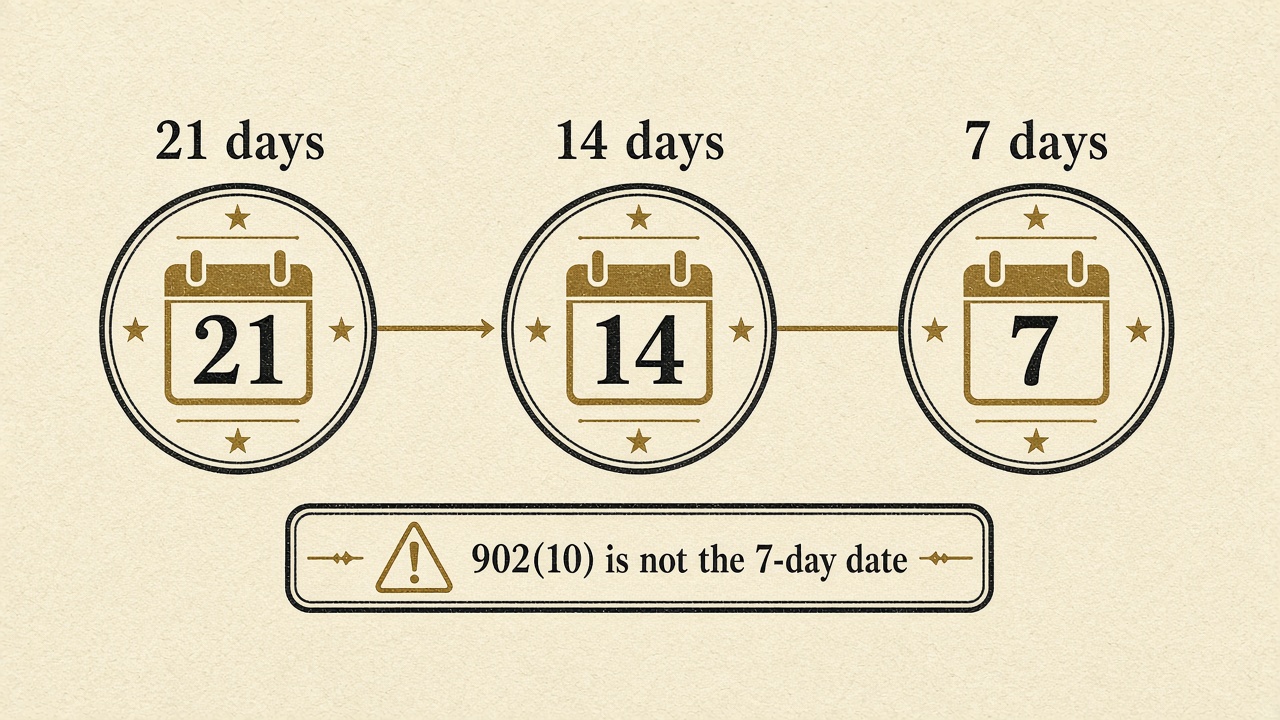
The way through it: have someone who knows how the files are kept swear to that by the deadline, and watch the other side’s deadline to object. The dates stack, often 21 days, 14 days, and 7 days, and they are not the same day. A shortcut for business records does not move the day the answer is due.
The client has a box. Ledgers, work orders, vendor invoices, an account history that has lived on a shared drive since 2019. A custodian signs a page that says “these are business records.” You file it with the motion or the response and assume the hearsay rule will finish the job. Then the objection lands. The court strikes the stack. What is left is a client affidavit full of conclusions and a hearing you no longer want. That is ordinary civil docket weather in Texas.

The exception is real. The self-authentication shortcut is real. Neither one cares how tidy the file looks in your office.
What the custodian actually has to swear to
Under Tex. R. Evid. 803(6), records of a regularly conducted activity can come in over a hearsay objection. Tex. R. Evid. 902(10) lets you skip the live witness if a custodian or other qualified witness executes an affidavit that substantially tracks the form in 902(10)(B). An unsworn declaration under Tex. Civ. Prac. & Rem. Code § 132.001 can stand in for a notary if you follow that statute’s text instead of improvising.
The affiant does not need personal knowledge of the underlying historical facts. They do need personal knowledge of the record-keeping system. Rule 166a(f) still requires the affidavit to show competence. “I am the custodian and these are our records” is not a system.
The five points that have to be in the paper, in substance:
The affiant is the custodian or another qualified witness who knows how the business keeps records. The records were made at or near the time of the act, event, condition, opinion, or diagnosis. They were made by, or from information transmitted by, a person with knowledge. They were kept in the course of a regularly conducted business activity. It was the regular practice of that activity to make the records.
Then attach the original records or exact duplicates. Identify them so a judge can tell the affidavit and the exhibit are the same animal. An affidavit that describes a stack you forgot to staple is not evidence. It is a cover letter.
Your ledger is not their invoice
In-house records are the easy pile. General ledgers, employee work orders, internal logs. A company custodian can usually talk about how those got made, when they got made, and why the business keeps them.
Third-party paper sitting in your client’s folder is a different problem. Mere possession does not convert a vendor invoice, an original-creditor statement, or an outside appraisal into your business record. If the affiant’s best line is “we received this from someone else and kept it,” you have described a file cabinet. You have not met Rule 803(6). On a timely objection, it comes out.
Texas courts have required more when an in-house witness tries to sponsor somebody else’s documents: incorporation into the business’s own records in the ordinary course, actual reliance on the accuracy of those documents in day-to-day operations, and circumstances that point to trustworthiness, such as a duty to submit accurate records, ongoing verification, or a real audit trail. Practitioners often point to Houston cases discussed as Simien v. Unifund CCR Partners and Airtouch Cellular v. Systems Facilitators, Inc. for that three-part idea. Those names and years need verification before they go in a brief. The practical point does not. Assigned-debt files get gutted all the time when the assignee cannot explain the handoff, the system migration, the accuracy check, and the continued reliance.
If your in-house person cannot swear to that, stop drafting around it. Get a 902(10) affidavit from the outfit that created the records, or serve a deposition on written questions with a subpoena duces tecum. Hoping the trial court will squint is not a foundation.
The calendar is the other hearsay rule
This is where competent evidence goes to die, especially when the only date on the calendar is the response deadline.
Tex. R. Civ. P. 166a(c) says the movant’s motion and supporting evidence must be filed and served at least 21 days before the hearing. The non-movant’s response and opposing affidavits are due not later than 7 days before. Tex. R. Evid. 902(10)(A) says the self-authenticating business-records affidavit and the attached records must be served at least 14 days before the day the evidence is offered.
Those clocks do not politely defer to one another.
If you are the movant, 166a(c) wins. You do not get to use 902(10)‘s 14-day notice to shrink a 21-day summary judgment deadline. File the motion, the affidavit, and the records at least 21 days out, and run Tex. R. Civ. P. 21a if service is not electronic. A 902(10) packet served 14 days before a summary judgment hearing is late as summary judgment evidence. On a timely objection, it is gone, leave of court aside.
If you are the non-movant, the trap is uglier. Rule 166a(c) lets you file the response 7 days before the hearing. Rule 902(10)(A) still wants 14 days before the records are offered. Serve the self-authenticating affidavit only with the response, and the other side can stand up and say you missed the condition precedent for skipping the live witness. Unless you authenticated some other way (live deposition, written-question deposition, a witness who can actually take the stand), you handed them the exclusion. Serve the 902(10) affidavit and the attached records at least 14 days before the hearing, even if the brief is still a week away. File a notice of filing so the clerk’s record matches what you served.
Count backward from the hearing
Start from the hearing date, not from the afternoon the client finally signed.
Well before day 21, sort the pile. Internal records in one stack, third-party paper in the other. Decide whether your affiant can actually speak to incorporation, reliance, and trustworthiness, or whether you need the originator. Draft the affidavit with all five 803(6) elements. Attach what the text describes. Bates it so nobody can pretend the exhibit mutated. Notary, or a Section 132.001 declaration that tracks the statute, not a homemade “under penalty of perjury” riff.
Day 21: movant’s hard stop. Motion, 902(10) affidavit, records, proper service.
Day 14: non-movant’s hard stop for the self-authentication shortcut. Serve the affidavit and the records. Do not wait because the response is “not due yet.”
Day 7: the response and the rest of the opposing proof. This is also when the objections get real. Defects in form (missing jurat, failure to say the records were made at or near the time, records not attached) are not the same as defects in substance (no competence, pure hearsay with no exception, conclusory recitals). In Texas state court, a form objection is waived for appeal if you did not make it in writing and get an express ruling. Rule 166a(f) is not moved by a silent docket.
Hearing day: obtain the ruling in writing, or clearly on the record, contemporaneously with or before the summary judgment order. “The court will take the objections with the motion” is how form complaints evaporate.
None of this makes the records true. It only keeps them in the file long enough for the court to read them. That is the whole game at summary judgment.
If you are lining up a similar stack against a hearing date, run the foundation and the two clocks through Texas Law Bot, the Texas Law Chatbot. It is a research tool, not counsel table.
This is commentary on general Texas legal research, not legal advice.