

Texas DWI: Per Se Limits, Drug Impairment, and Why the Stop and Blood Draw Matter
Texas can prove DWI with a 0.08 alcohol number or with loss of normal faculties, including drugs that have no legal cutoff. Penalties climb with priors, a child in the car, and high BAC, and a lot of the real fight is whether the stop and the blood draw were legal.
TL;DR
The problem: a driver is accused of being drunk or on drugs, and people treat a lab number as the whole case. For alcohol, 0.08 can be enough. For drugs, the law has no number.
The way through it: separate the two tests. One is 0.08 alcohol. The other is that the driver could not use their mind or body normally, which is how drug cases are usually proved. Then check why the officer pulled the driver over, and how the blood sample was taken. A lab report by itself is not a conviction.
The shoulder of a farm-to-market road, ten minutes after a lane change. The driver thinks the case is a breath score. The State is already building two definitions of “intoxicated,” a penalty ladder that can walk a first arrest from county jail toward TDCJ, and a suppression fight that still turns on the stripe and a magistrate’s signature.
Two ways to be “intoxicated”
Driving while intoxicated lives in Tex. Penal Code § 49.04. The word that does the work is “intoxicated,” and that word has two meanings in § 49.01(2).
The per se path is § 49.01(2)(B): an alcohol concentration of 0.08 or more. Section 49.01(1) defines that number as 0.08 grams of alcohol per 100 milliliters of blood, 210 liters of breath, or 67 milliliters of urine. Prove that concentration at the time the person operated the vehicle, and the State does not have to prove anyone looked impaired. No weaving required. No slurry speech required. The number is the element.
That shortcut is alcohol only. It does not apply to THC, opioids, benzos, or whatever else showed up in a qualitative tox report.
The impairment path is § 49.01(2)(A): not having the normal use of mental or physical faculties by reason of alcohol, a controlled substance, a drug, a dangerous drug, a combination of those, or any other substance. That is the only theory available for a drug DWI. Texas has no statutory nanogram limit for delta-9 THC and no legal cutoff for prescription painkillers. Every drug case has to be built the old way. Driving or roadside performance, plus a nexus to the substance: field sobriety tests, a Drug Recognition Evaluator, admissions, qualitative toxicology. A lab printout without the behavior is not a per se conviction.
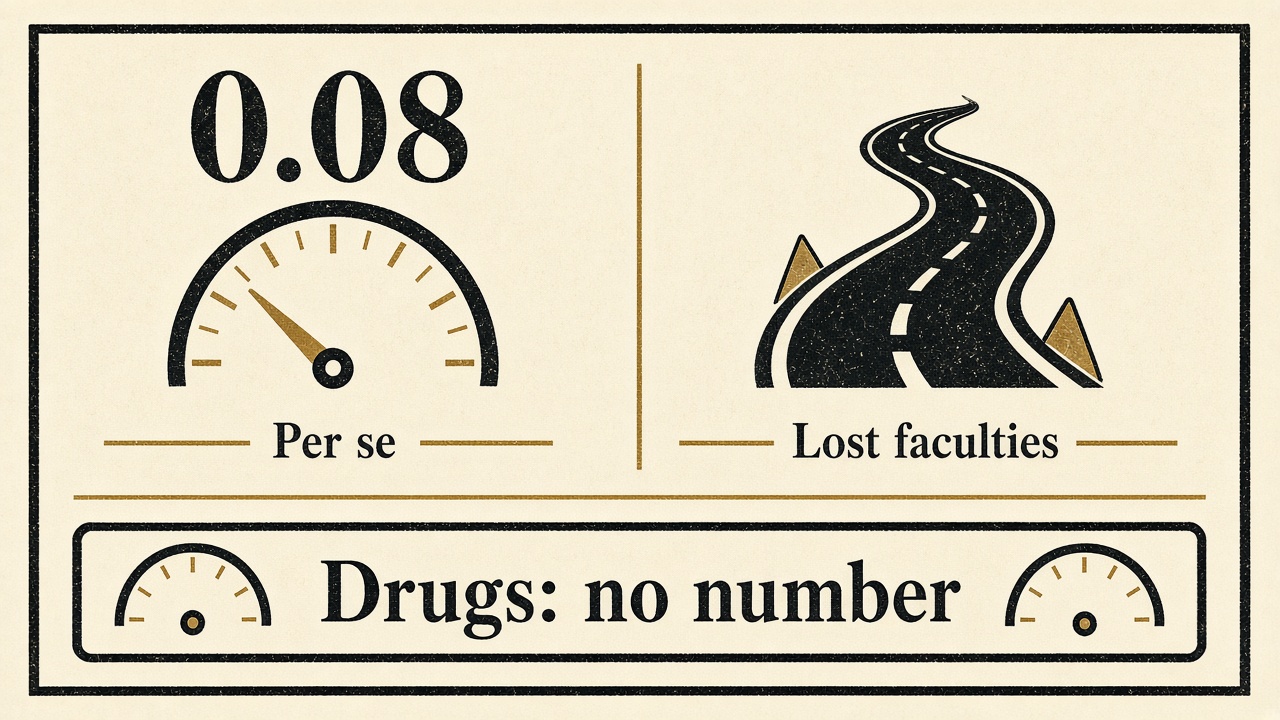
People get this backward in both directions. A 0.07 does not close the file if the State can still prove impairment. A marijuana DWI does not work like a 0.08 case.
If a lot of time passed between the driving and the test, prosecutors sometimes try retrograde extrapolation to walk a later number backward to the time of driving. That testimony has scientific baggage: last drink, food, absorption phase, and the rest. Mata v. State is the name that gets thrown around. Treat it as a research lead, verify the current requirements, and do not assume every chemist on the State’s list can do that math.
The penalty ladder, which is not subtle
A plain first DWI is a Class B misdemeanor under § 49.04(b), with a 72-hour minimum. An open container in the passenger compartment bumps that minimum to six days under § 49.04(c). If blood, breath, or urine shows 0.15 or more at the time the analysis was performed, it is a Class A under § 49.04(d). Read that last phrase twice. The statute keys the 0.15 bump to the time of the analysis, not a courtroom reconstruction of the drive.
One prior conviction relating to operating a motor vehicle while intoxicated puts you in Class A territory with a 30-day minimum under § 49.09(a). Two priors, and § 49.09(b)(2) makes it a third-degree felony. A passenger younger than 15 is a state jail felony all by itself under § 49.045, even on a first arrest.
Cause serious bodily injury by accident or mistake while intoxicated, and it is intoxication assault under § 49.07, a third-degree felony. Cause a death, and it is intoxication manslaughter under § 49.08, a second-degree felony. If the person killed is a peace officer, firefighter, or emergency medical services personnel in the line of duty, § 49.09(b-1) and (b-4) can take it into first-degree range.
None of that requires a long rap sheet. A child in the car, a second trip through the system, or the injury and death offenses will do the elevating. The enhancement facts are the case.
The stop, where a lot of these files actually start
Suppression in Texas DWI work is a Fourth Amendment problem and a Tex. Code Crim. Proc. art. 38.23 problem. Article 38.23 is the statutory exclusionary rule. It bars evidence obtained in violation of the U.S. Constitution, the Texas Constitution, or Texas law. If there is a fact issue about how the evidence was obtained, the court can be required to instruct the jury to disregard it if jurors believe, or have a reasonable doubt, that it was obtained illegally. That instruction is not a courtesy. It is a statutory lever federal practice does not always give you.
The first fight is the stop. Officers need specific, articulable facts, plus rational inferences, pointing to criminal activity. Tex. Const. art. I, § 9 sits next to the Fourth Amendment on that point.
The usual Transportation Code hooks are familiar. Failure to drive within a single lane, Tex. Transp. Code § 545.060. Failure to signal, § 545.104, including the 100-foot rule. Equipment, like plate lamps under § 547.322 or taillights under § 547.3215. The lane-weave cases have a long argument about whether leaving the lane has to be unsafe before it is even an offense. Leming v. State is the name people cite. Verify current Court of Criminal Appeals treatment before you bet a motion on a drift across the stripe.
A cop’s mistake of law about what the Transportation Code actually forbids is a problem here. Article 38.23 does not hand the State the federal Heien v. North Carolina cushion for a reasonable mistake of law. If the statute did not prohibit what the officer thought it prohibited, the stop can fall.
Then comes the clock. A stop for speeding is a stop for speeding. Stretching it into field sobriety tests requires independently acquired reasonable suspicion of intoxication, developed before the original traffic mission is finished. Rodriguez v. United States is the U.S. Supreme Court case on prolongation. Confirm how Texas courts are applying it. The extra ten minutes on the shoulder are not small talk. They are the detention.
The blood draw is still a search
A forced blood draw is a search. The research trail runs through Schmerber v. California and Missouri v. McNeely. Verify the current application. The practical Texas rule is not mysterious. You need a warrant, voluntary consent, or real exigent circumstances. Alcohol fading in the bloodstream, by itself, is not a standing emergency.
Warrants live in Chapter 18. Tex. Code Crim. Proc. art. 18.01 and art. 18.02(a)(10) require a sworn affidavit with probable cause that an offense occurred and that the blood will produce evidence of it. Magistrate authority is not a formality. Articles 18.01(c) and 18.01(j) limit who can sign certain evidentiary warrants. The wrong magistrate can make the paper void, which is an Article 38.23 problem, not a clerk’s typo.
Texas also has implied consent. Tex. Transp. Code § 724.011 says a person arrested for a Chapter 49 offense is deemed to have consented to a breath or blood specimen. Section 724.012(b) goes further and purports to require warrantless draws in some high-consequence cases: child passenger, death or serious injury, two or more prior DWIs. The Texas Court of Criminal Appeals has held that those “mandatory” Chapter 724 provisions do not create a per se exception to the Fourth Amendment warrant requirement. State v. Villarreal is the citation that gets used. Verify it, then do not treat a statutory mandate as a constitutional free pass. A warrantless draw justified only by § 724.012, with no warrant, no true exigency, and no actual consent, is built to lose.
When the State claims consent, it has to be free and voluntary, not a nod to a claim of lawful authority. Telling someone a warrant is already signed when it is not, or that refusal means they will be held for a draw anyway, is how consent dies. The DIC-24 warnings are part of that conversation. They are not a magic waiver.
Who draws the specimen matters too. Section 724.017 limits forensic draws to a physician, qualified technician, chemist, registered professional nurse, or licensed vocational nurse. The wrong person is a reasonableness fight and a statutory one.
Hospital blood drawn for treatment is a different problem. The Fourth Amendment may not attach to the medical draw the same way it attaches to an officer demanding a forensic specimen. Getting the hospital records still requires process, often a grand jury subpoena or a warrant under art. 18.0215, with the usual HIPAA caveats. State v. Martinez shows up in that discussion. Verify before you treat hospital specimens as either automatically in or automatically out.
The boring work that decides the motion
Check Texas Legislature Online for the last couple of sessions. Magistrate warrant authority under art. 18.01, remote and electronic warrant practice, and the repeat-offender pieces of § 49.09 have a habit of moving. A blog post is a snapshot. The live Code is the one that counts.
The trap is not a secret doctrine. It is the assumption that 0.08 is the whole crime, that drugs work like alcohol, that implied consent means they can take blood because a pamphlet said so, or that a sloppy lane change is always a lawful stop. Texas DWI practice is two theories of intoxication, a penalty chart that punishes priors and passengers, and a suppression docket that still cares about reasonable suspicion and a valid warrant.
I am not your lawyer. If you want to run a similar question against the statutes, try Texas Law Bot, the Texas Law Chatbot, and see how the Code talks about stops, blood, and enhancements. It is a research tool, not counsel table.
This is commentary on general Texas legal research, not legal advice.